

How to: Use the Multi Lift Opportunities Report
Crane productivity is a key measure for a busy terminal. The Multi Lift Opportunities Report estimates how many twin, tandem, triplet and quad moves your quay cranes could do when the vessel discharged and loaded. A multi-lift move lifts more than one container at once. Use the report to measure your current productivity and to make better operational decisions.
The result is an estimate from the rules in How the report finds multi-lift opportunities below. It does not use real crane data.
The mode Multi-Lift is in the Mode list only for accounts that can use it. You need a membership that includes Multi-Lift, and Admin or Edit permission for the facility. Guest users and accounts that have expired cannot use it. If you do not see the mode, ask your Facility Administrator or contact Support.
Before you start: upload your Inbound BAPLIE file (used for discharge moves) and open it for viewing. The report runs for the file that you opened. If you also want the result for the outbound voyage and the total, upload the Outbound BAPLIE file (used for load moves) too. You choose it later in step 7.
Open Multi-Lift mode
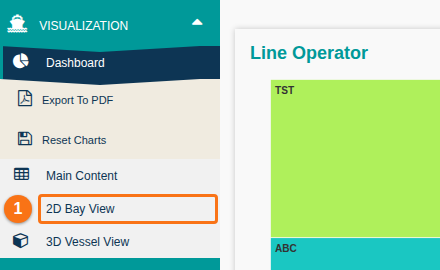
Section titled “Open Multi-Lift mode”- In the Function Menu on the left, open Visualization and click 2D Bay View (1 in the picture).
- In the top bar, click the Mode dropdown (1 in the picture) and choose Multi-Lift. The bar shows Change Calculation Parameters and MultiLift Summary in PDF. In this mode, the bay list, the view control and the right panel are switched off.

Set the calculation parameters
Section titled “Set the calculation parameters”The first time that you (or anyone in your facility) use this feature, the window Calculation Parameters opens by itself. You must set the parameters. The system saves them for your facility. Everyone in your facility then uses the same settings. If anyone changes the parameters, they change for the whole facility.
- To set or change the parameters later, click Change Calculation Parameters. The Calculation Parameters window opens.
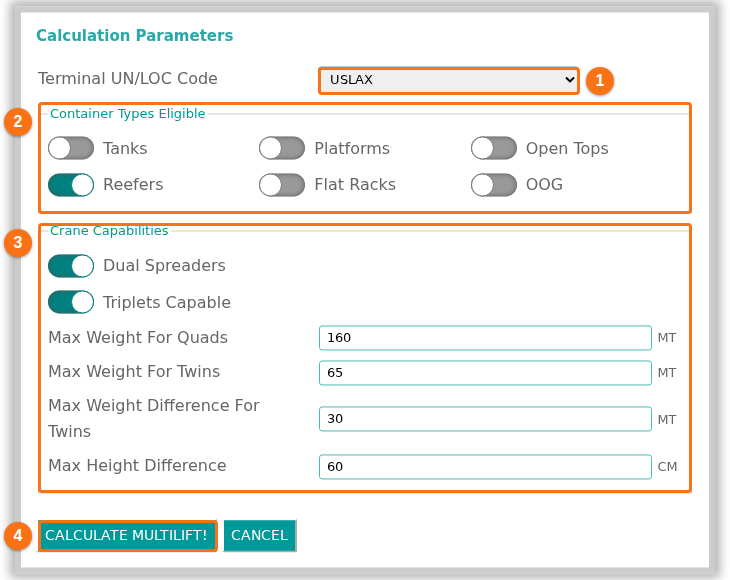
- Set these fields (the numbers are in the picture):
| Field | What to do |
|---|---|
| Terminal UN/LOC Code (1) | Choose your port. The list has the unique POD (port of discharge) and POL (port of load) values from the file. The application uses the code as the POD value for discharge moves and as the POL value for load moves. It considers only the containers where the POD or the POL is this code. It leaves out all other containers. You must choose a port. |
| Container Types Eligible (2) | Tick the container types that can be multi-lifted: Tanks, Platforms, Open Tops, Reefers, Flat Racks, OOG. A type that is not ticked is not allowed in a multi-lift. The first time, only Reefers is ticked. Open tops are left out only when they are full. |
| Dual Spreaders (3) | Tick this if your quay cranes have independently controlled dual spreaders and dual hoists. You need it for tandems, triplets and quads. |
| Triplets Capable (3) | Tick this if your cranes can lift two 20’ containers and one 40’ container. If Dual Spreaders is not ticked, this box is empty and you cannot change it. If your equipment or TOS (terminal operating system) cannot handle triplets, clear it. |
| Max Weight For Quads (3) | The most total weight for a quad or a triplet, in metric tonnes (MT). A whole number. At first: 160. |
| Max Weight For Twins (3) | The most total weight for a twin or a tandem, in metric tonnes (MT). A whole number. At first: 65. |
| Max Weight Difference For Twins (3) | The most weight difference between the two containers on one spreader, in metric tonnes (MT). Triplets and quads use it too. A whole number. At first: 30. |
| Max Height Difference (3) | The most height difference between the tops of the containers on one spreader, in centimetres (CM). A whole number. At first: 60. |
- Click CALCULATE MULTILIFT! at the bottom of the window (4 in the picture). To close the window without calculating, click CANCEL. If you did not choose a port, the window Validation Errors opens. Close it, choose the port and click CALCULATE MULTILIFT! again.
Read the Multi-Lift report
Section titled “Read the Multi-Lift report”The report opens with a panel on the left. It has four parts. At the right edge of the panel are three tabs: Inbound, Outbound and Total Summary (1 in the picture). The table of moves by bay is next to the tabs (2 in the picture).
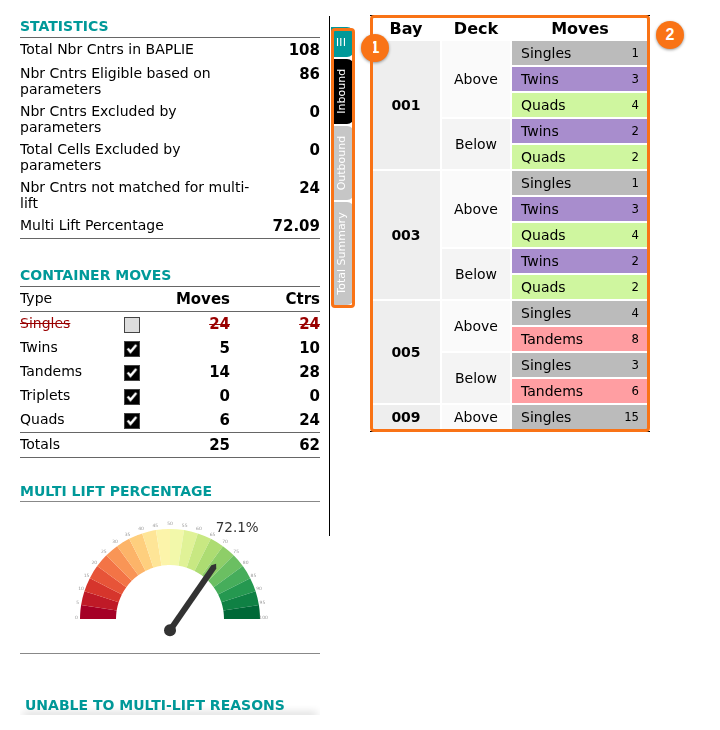
STATISTICS shows:
- Total Nbr Cntrs in BAPLIE: the number of containers that the report counted. It does not count containers with a position that cannot be used.
- Nbr Cntrs Eligible based on parameters: the number of containers that can be multi-lifted with your parameters.
- Nbr Cntrs Excluded by parameters: the number of containers left out because of your parameters, for example a container type that is not ticked. It does not count containers left out because of the port.
- Total Cells Excluded by parameters: the number of twenty-foot slots left out by your parameters. A 40-foot container counts as 2.
- Nbr Cntrs not matched for multi-lift: these containers can be multi-lifted, but cannot be paired with another container with your crane parameters.
- Multi Lift Percentage.
CONTAINER MOVES shows the number of moves (Moves) and containers (Ctrs) for each type. The last row, Totals, adds them. A type that the file does not have shows 0.
| Type | What it is |
|---|---|
| Singles | One container. |
| Twins | Two 20-foot containers. |
| Tandems | Two 40-foot containers. |
| Triplets | One 40-foot container and two 20-foot containers. |
| Quads | Four 20-foot containers. |
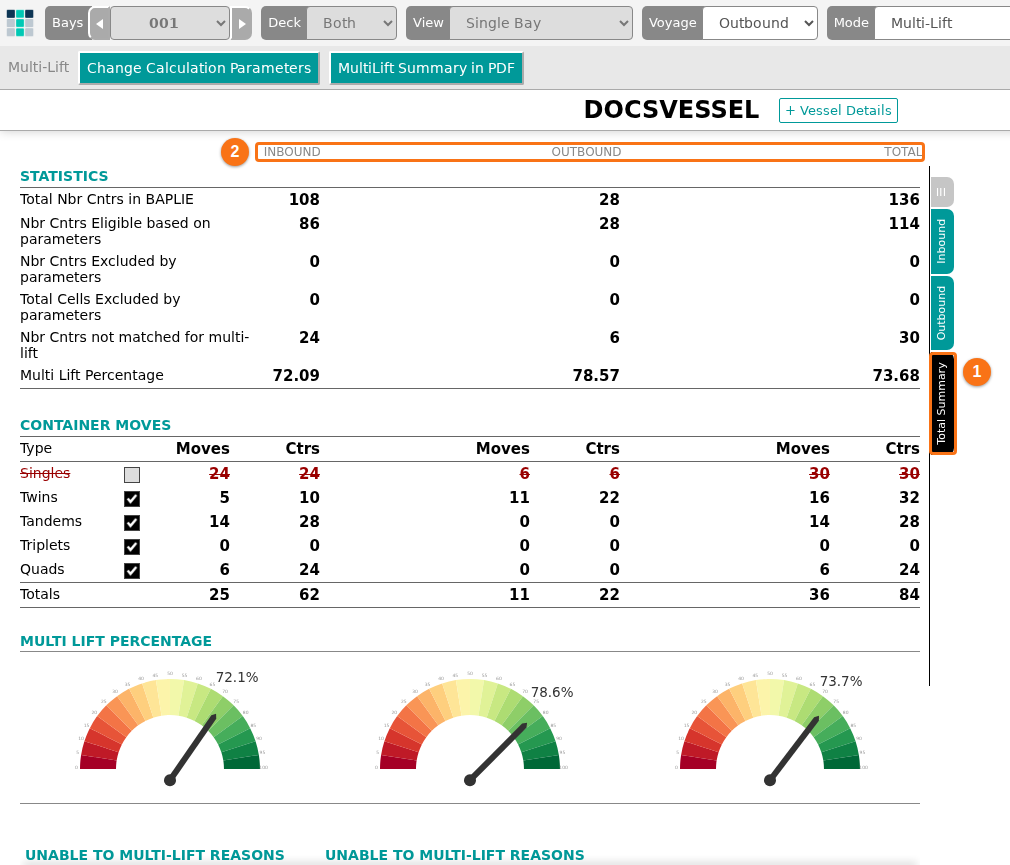
Each type has a check box. Click the name of a type to include it in the totals or to leave it out. In the picture, Singles is not ticked and its numbers are crossed out. At first, Singles is left out. The application remembers your choice. Single moves then do not count in the total move count and the total container count.
MULTI LIFT PERCENTAGE shows a gauge with the percentage of containers that can be handled by multi lift. It is the number of containers in the ticked types, divided by the sum of the eligible containers and the excluded containers.
UNABLE TO MULTI-LIFT REASONS shows the main reasons why containers could not be part of a twin, a triplet, a tandem or a quad move. For each reason, it shows how many times it happened. The reason can be the height difference, a weight that is too high, a partner container that is not eligible, or a container type that is not allowed (for example “Reefers not eligible”). It can also be a port that is not the terminal code.
Switch between Inbound and Outbound
Section titled “Switch between Inbound and Outbound”- In the top bar, click the Voyage dropdown (1 in the picture) and choose Outbound.

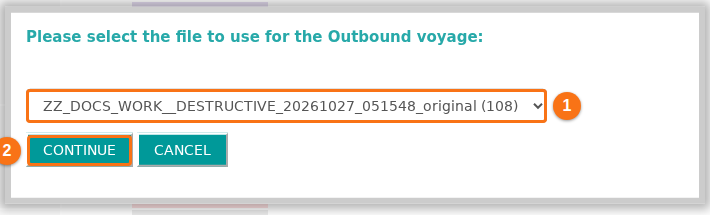
- A window asks: “Please select the file to use for the Outbound voyage”. Choose the Outbound file in the dropdown (1). Files that you uploaded before with the same vessel name show in the list. Click CONTINUE (2).
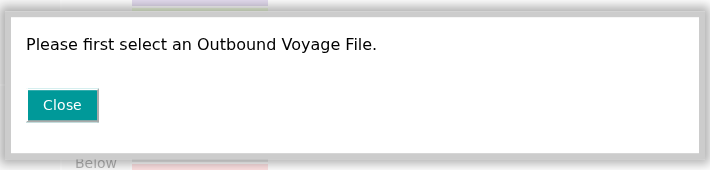
- Now you can switch between the two files without a page reload. The application calculates each voyage with the same parameters. Click the Inbound, Outbound or Total Summary tab. Total Summary shows the result for both voyages. If you click Total Summary before you choose an Outbound file, a window says Please first select an Outbound Voyage File. Click Close and do steps 6 and 7.
After you choose the Outbound file, click the Total Summary tab (1 in the picture). The report shows the columns INBOUND, OUTBOUND and TOTAL side by side (2 in the picture). Each column has the statistics, the container moves and the multi lift percentage.
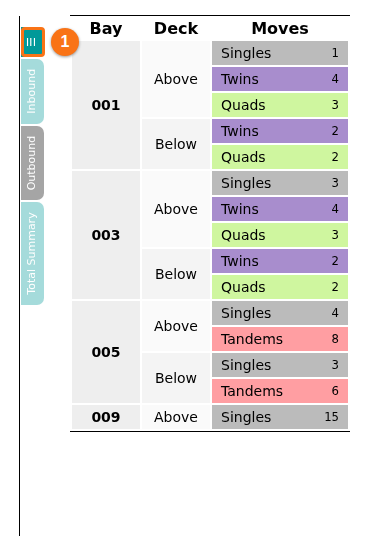
- To hide the left panel, click the menu button (1 in the picture) at the top of the side tabs.
Look at the moves by bay
Section titled “Look at the moves by bay”Next to the panel, the table Containers by Bay > Move Types shows the eligible moves by Bay, Deck and Moves (move type). The colors are:
| Color | Move type |
|---|---|
| Grey | Singles (cannot be multi-lifted) |
| Purple | Twins |
| Pink | Tandems |
| Turquoise | Triplets |
| Green | Quads |
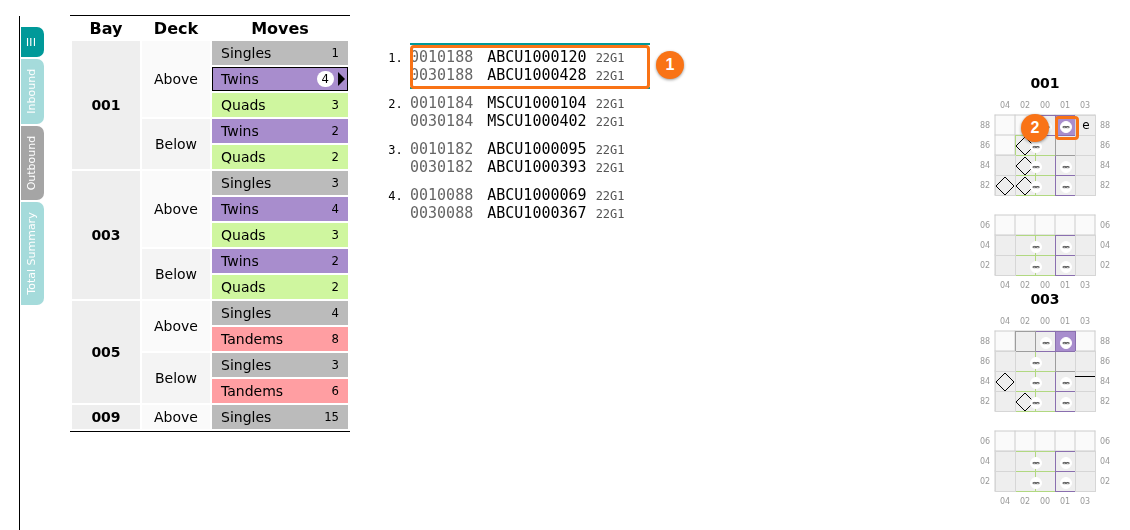
- Click a move type, for example Twins (1 in the picture). A list opens next to the table (2 in the picture), and a 2D mini view of the bays opens (3 in the picture). The containers have the color of their move type. The list has one entry for each move. An entry shows the containers of the move, with their position, container number and ISO code (the container size and type code). A twin move has two containers.
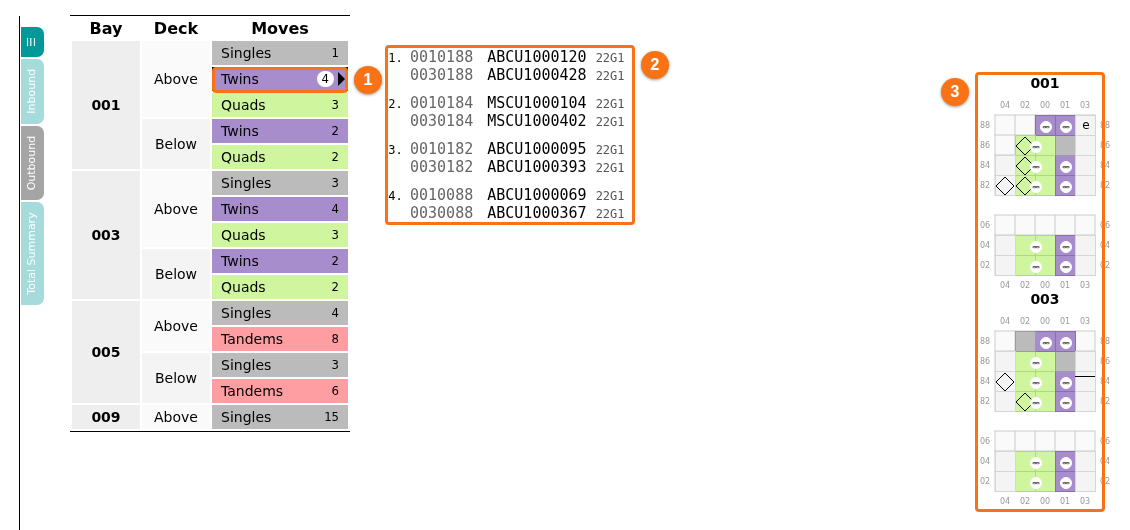
- Point to an entry in the list (1 in the picture). The container is highlighted in the 2D mini view (2 in the picture). The other containers turn grey.
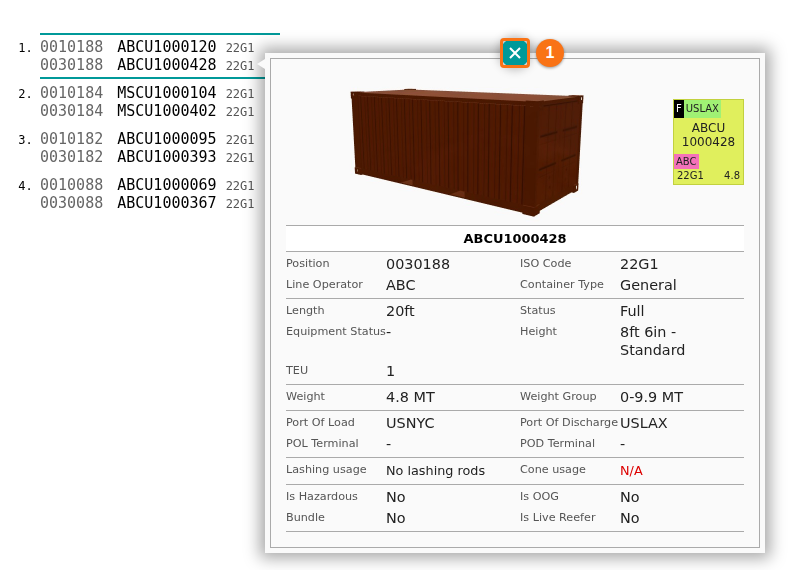
- Click a container number. The container information window opens with all details of the container. To close it, click the x button (1 in the picture).
- You can also point to a container in the 2D mini view. The container is then highlighted in the container list. It looks like the picture in step 11.
See the whole vessel in 2D View
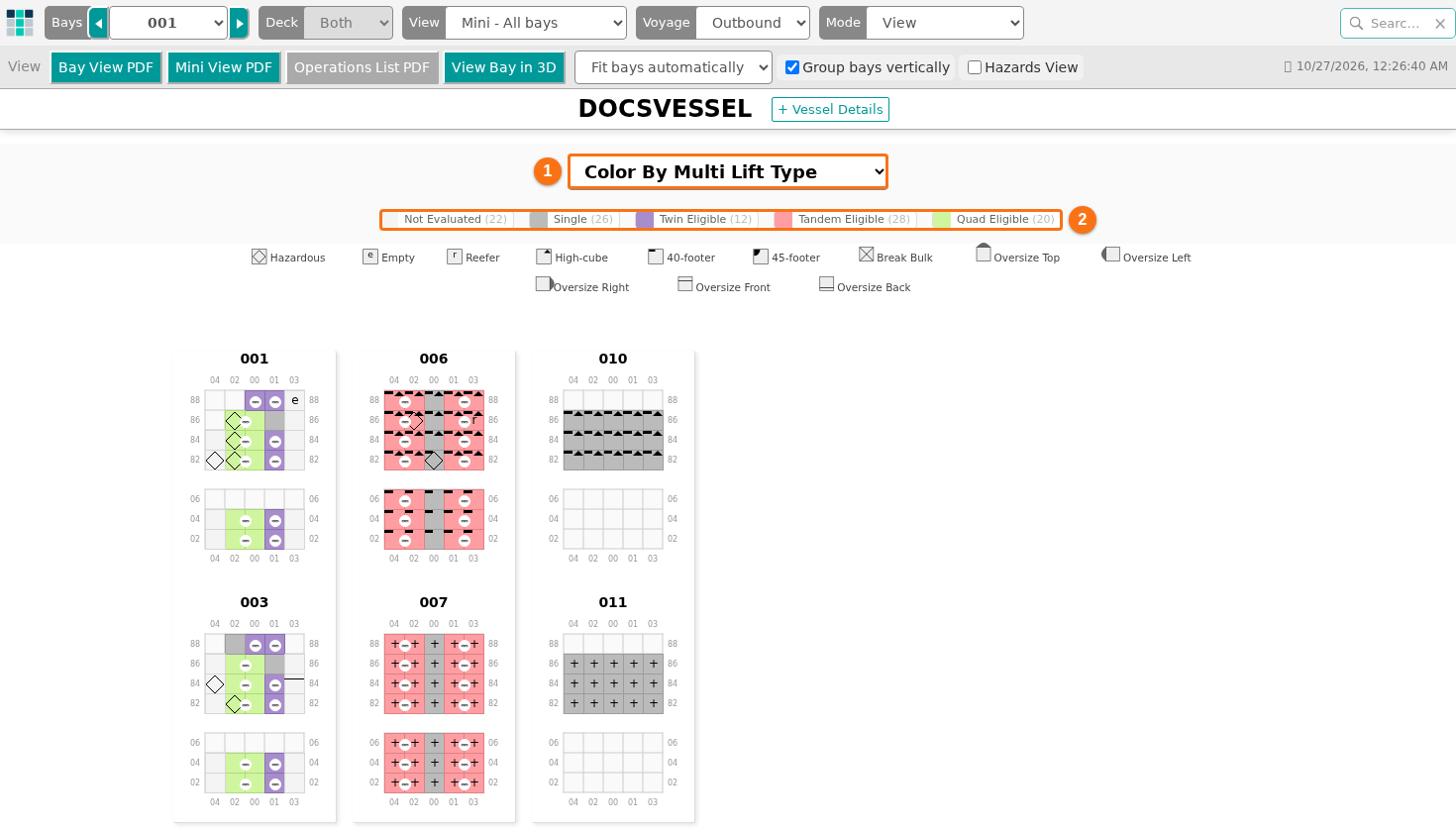
Section titled “See the whole vessel in 2D View”To see all multi-lift containers on the vessel, color the 2D view by multi-lift type. You can do this after you have calculated multi lift one time for the file.
- Change the Mode dropdown (1 in the picture) from Multi-Lift to View.

- In the view control at the top, choose Mini Bays.
- In the Color & Filter panel on the right, open the Colour by list and choose Multi Lift Type.
The list under Colour by shows Not Evaluated, Single, Twin Eligible, Tandem Eligible, Triplet Eligible and Quad Eligible, with the number of containers for each. The mini view uses the same colors as the report: grey for singles, purple for twins, pink for tandems, turquoise for triplets and green for quads. Containers that are Not Evaluated are near white. The container window also shows the multi-lift type and the reasons.
Print or share the report
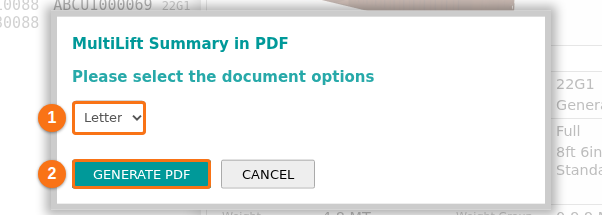
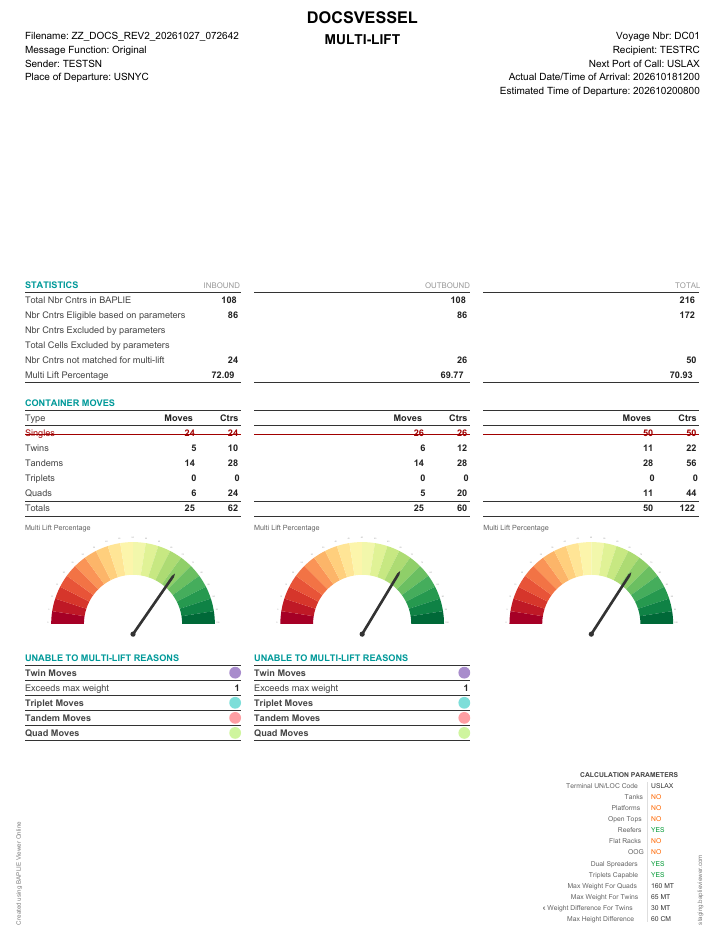
Section titled “Print or share the report”- In the top bar, in Multi-Lift mode, click MultiLift Summary in PDF (the orange box in the first picture). The button is grey until the calculation is ready. The MultiLift Summary in PDF window opens with a list for the paper size, for example Letter (1 in the second picture). If your facility has a logo, you can also choose to add it. Click GENERATE PDF (2 in the second picture). When the PDF is ready, click Download PDF. The Multi Lift Summary is a PDF that you can share and print.

- The PDF is one portrait page called MULTI-LIFT. It shows the details of the ship and the voyage and the same reports as the screen. If you evaluated only the Inbound file, the PDF shows only that result. If you also evaluated the Outbound file, it shows both and the total. A move type that you left out of the totals is crossed out. At the bottom, the PDF lists the calculation parameters that you used.
How the report finds multi-lift opportunities
Section titled “How the report finds multi-lift opportunities”The report reads the containers of the file and pairs them with simple rules. It does not use real crane data. Read this section to understand the numbers.
Which containers count
Section titled “Which containers count”- The report skips a container with a position that cannot be used. This is a position that starts with a letter, is in bay 000, is shorter than 7 characters, or is marked as invalid. The report does not count these containers.
- The report considers a container only if its POD or its POL is the Terminal UN/LOC Code. It leaves out all other containers. They are not even singles.
- The report leaves out a container if its type is not ticked in Container Types Eligible. Open tops are left out only when they are full.
- Above deck means tier 68 and higher. The report looks at above deck and below deck separately.
- The length of a container comes from the first character of its ISO type code: 2 is 20 feet, 4 is 40 feet, and L or 9 is 45 feet. If the ISO code is not usable, an even bay means 40 feet and an odd bay means 20 feet.
- The height of a container comes from the second character of its ISO code. For example 2 or 3 is 8.5 feet, 4 is 9 feet and 5 is 9.5 feet.
- The weight of a container is the VGM weight (the verified gross mass) if the file has one. If not, it is the gross weight.
How the containers are paired
Section titled “How the containers are paired”- The report checks each container once. A container is in at most one move.
- For each bay, row and tier, the report pairs the rows from the outside of the vessel to the center line. A row is paired with the next row toward the center. For example, row 04 is paired with row 02, and row 02 with row 00. If the vessel has no row 00, row 02 is paired across the center line with row 01.
- In odd bays, the report looks for quads first, then triplets, then twins. In even bays, it looks for tandems first, then triplets. Because the report uses each container once, the order changes the result.
| Move | What the report looks for |
|---|---|
| Quad (needs Dual Spreaders) | Four 20-foot containers on the same tier in bay N and bay N+2 (N is 001, 005, 009 and so on). Two are in one row and two are in the paired row. The total weight is at most Max Weight For Quads. In each pair, the weight difference is at most Max Weight Difference For Twins and the height difference is at most Max Height Difference. |
| Triplet (needs Dual Spreaders and Triplets Capable) | Either one 40-foot container in an even bay with a 20-foot container on the same tier in the odd bay before it and after it (in the paired row), or a pair of 20-foot containers in bays N and N+2 (same row) with a 40-foot container in the even bay between them (paired row). The limits are the same as for a quad. |
| Twin | Two 20-foot containers in the same row and on the same tier in bay N and bay N+2. The bays 003, 007 and so on are only partners. The total weight is at most Max Weight For Twins. The weight difference is at most Max Weight Difference For Twins. The height difference is at most Max Height Difference. |
| Tandem (needs Dual Spreaders) | Two 40-foot or 45-foot containers in the same even bay and on the same tier, in a row and in its paired row. The total weight is at most Max Weight For Twins. The height difference is at most Max Height Difference. |
| Single | Every eligible container that the report could not pair. Also every container that is not eligible for a reason other than the port. |
The height difference compares the top of each container. The top is the height of the stack up to and including that tier, measured from the hatch cover (above deck) or from the tank top (below deck).
Good to know
Section titled “Good to know”- The report has a row for Triplets. Triplets can be handled only when Triplets Capable is on. When the file has no triplet moves, the row shows 0.
- The parameters are saved for your whole facility. If a colleague changes them, your next calculation uses the new values.
- The report changes the multi-lift type and the reasons of the containers in your view. It does not change your BAPLIE file.